
Lead Magnet Funnel for Coaches: The CRMX SIGNAL Loop
Build a lead magnet funnel that turns a coach's expertise into qualified conversations, booked calls, useful follow-up, and measurable next steps.

A lead magnet funnel for coaches should do more than trade a PDF for an email address. It should help the right person understand a problem, tell you what they need, and move into the next useful conversation.
That is the difference between collecting contacts and creating qualified demand.
Brent Attaway's Five Fortune Engines makes the sequence clear: earn attention, capture permission, follow up, create a reliable conversion path, build an experience worth talking about, and automate the parts that should happen consistently. For coaches and consultants, one well-designed lead magnet can connect all six engines.
The practical model is the CRMX SIGNAL Loop: Specific problem, Intent capture, Guided conversation, Next-best calendar, Automated follow-up, and Learning loop.
The strategy: build around one useful decision
The strongest lead magnet is not the longest. It is the one that helps a specific person make a specific decision.
Current Google guidance on people-first content asks whether content serves an intended audience, demonstrates first-hand expertise, adds original value, and leaves the reader able to achieve a goal. That is a useful standard for a lead magnet even when search is not the main traffic source.
Instead of creating The Ultimate Guide to Leadership, a leadership consultant could create The 90-Day Leadership Friction Map. Instead of How to Grow Your Business, a business coach could offer The Growth Bottleneck Scorecard.
The narrower asset is stronger because the reader can recognize the problem and understand what the result will help them decide.
Use this three-question asset test:
- Does it solve one problem the audience already knows it has?
- Does the result naturally reveal a useful next step?
- Can the coach explain that next step without forcing every person into a sales call?
If any answer is no, tighten the asset before adding software.
Why most coaching lead magnet funnels stall
Most funnels do not fail because the form button is the wrong color. They stall in the handoffs.
- The attention is vague. The asset promises broad inspiration instead of one concrete outcome.
- The form captures data without intent. Every lead looks identical after submitting.
- The follow-up repeats the download link. It does not help the person interpret or use the asset.
- The calendar becomes the only next step. A curious visitor and a ready buyer receive the same invitation.
- The system measures downloads. It cannot show which leads became conversations, qualified opportunities, calls, or clients.
The SIGNAL Loop fixes those handoffs by giving every stage one job and one visible outcome.
The CRMX SIGNAL Loop
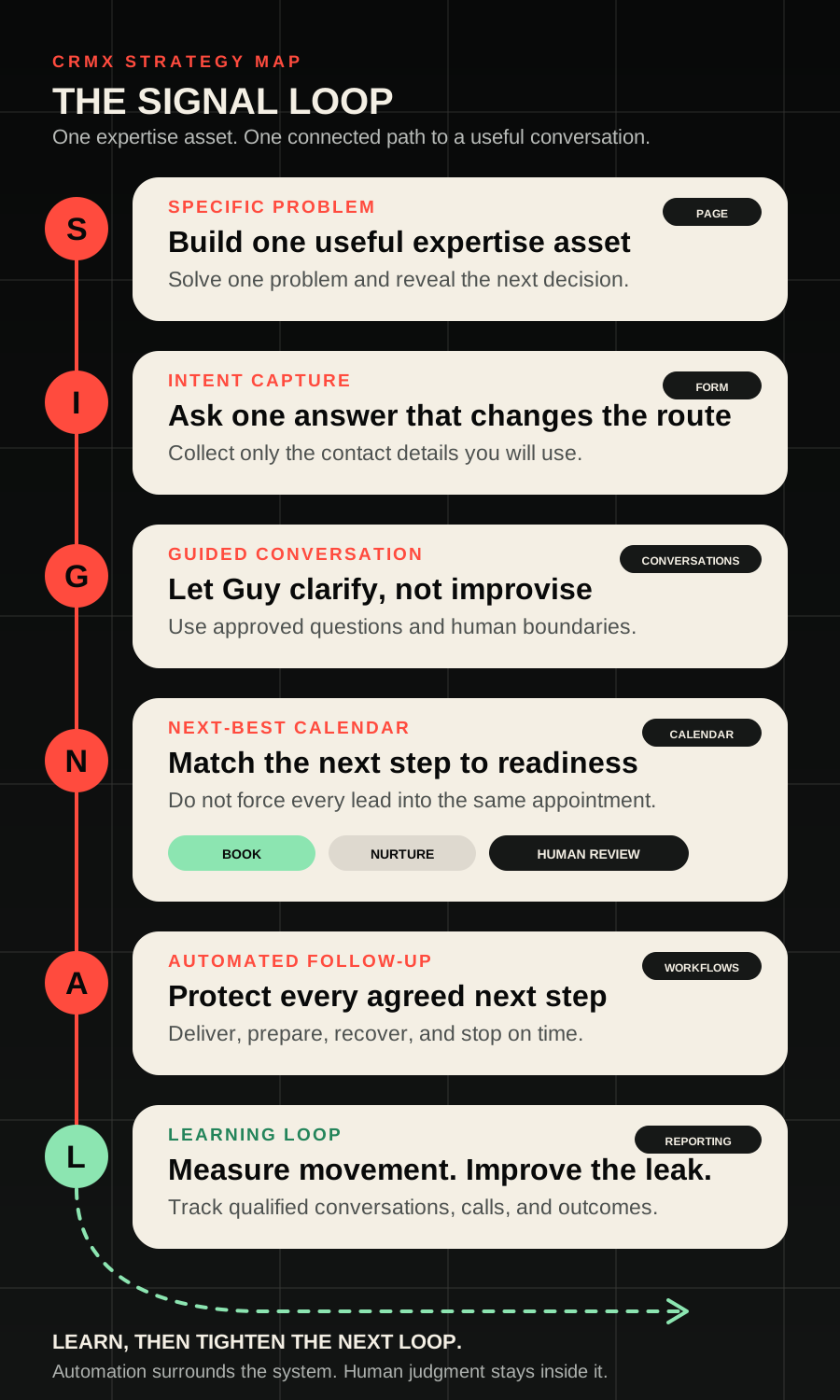
S — Specific problem
Start with a problem small enough to diagnose in a few minutes and important enough to change what the person does next.
Good formats include:
- a scorecard that identifies the weakest stage in a process;
- a checklist that exposes missing prerequisites;
- a short assessment that routes people by situation;
- a planning template that produces one decision;
- a calculator that makes an assumption visible.
The asset is the bridge from the Attention Engine to the Lead Capture Engine. Your message earns the look. The asset earns permission to continue.
I — Intent capture
Capture the minimum contact information your team genuinely needs, plus one question that changes the route.
For a coach, that may be:
- name;
- email or phone, based on the promised delivery and follow-up channel;
- one intent question such as, “Which result are you trying to improve first?”
Google's current lead-form guidance emphasizes clear calls to action and relevant questions, including qualifying answers when they improve routing. The principle is simple: ask a question only when you will use the answer immediately.
Do not turn the first form into a full intake. A short intent signal is enough to personalize the next step. Save sensitive, detailed, or unnecessary questions for the point where they are actually required.
G — Guided conversation
Delivery should begin a conversation, not end one.
A trained CRMX AI employee can acknowledge the asset request, reference the selected answer, and ask one approved follow-up question. Guy should sound like a capable guide to the coach's process, not a generic bot pretending to be the coach.
For example:
You chose follow-up as the bottleneck. Is the bigger gap getting the first reply, keeping appointments, or following up after the sales conversation?
The answer creates useful context for the contact record and the human team. If the question falls outside approved knowledge, the conversation should route to a person with the asset, original answer, and current question attached.
N — Next-best calendar
The best next step is not always “book a call.” It is the next step that matches the person's intent and readiness.
- Ready and within fit: offer the correct consultation calendar.
- Interested but still diagnosing: send the relevant explanation and continue a short nurture path.
- Outside the defined fit: offer a useful resource or human review instead of forcing a booking.
For the ready path, make the appointment name specific. Growth Bottleneck Review creates a clearer expectation than Free Discovery Call. Use the pre-call confirmation to explain what will be discussed, what to bring, and what will happen afterward.
A — Automated follow-up
Automation should protect the promise made at the prior step.
Build separate paths for:
- Asset requested, no conversation: deliver the asset, ask one useful question, and continue a short value sequence.
- Conversation started, not ready: send material matched to the stated problem and create a dated next review.
- Call booked: confirm, prepare, remind, and stop lead-nurture messages that no longer fit.
- Cancellation or no-show: acknowledge what happened and offer a clean rebooking path.
- Call held, no decision: follow up on the actual question or agreed next step.
Use CRMX conversations, workflows, pipelines, and calendars to keep those states connected. Stop conditions matter as much as start conditions: a reply, booking, opt-out request, human takeover, or final outcome should prevent stale automation from talking over the real conversation.
L — Learning loop
The final stage turns activity into a better system.
Track movement through stages that describe what is true now:
- Asset Requested
- Conversation Started
- Qualified
- Call Booked
- Call Held
- Next Step Open
- Client
- Not Now
- Outside Fit
This makes the Conversion Engine visible. It also reveals whether the leak is the offer, form, first conversation, qualification, calendar, show-up process, or post-call follow-up.
If your measurement plan uses Google Analytics, its current recommended event reference distinguishes lead generation, qualification, active lead work, and converted or unconverted outcomes. CRMX does not need to copy those names internally, and this article does not assume they are emitted automatically. The useful idea is to measure deeper than the download.
After someone becomes a client, keep the loop connected. Gather feedback at meaningful milestones, improve the experience, and make any later review or referral invitation a consequence of value delivered. That is where the Raving Fan Engine begins.
Build the funnel in CRMX step by step
1. Create one asset and one landing path
Build a focused page or funnel around one promise. The headline should name the problem and the outcome. The page should explain who the asset is for, what it helps them decide, and what information is required to receive it.
If you need the broader page strategy first, use the guide to building an AI-first website that moves leads toward a customer.
2. Add one routing question
Choose a question whose answer changes the next message, owner, resource, or calendar. Avoid questions that simply make the form look sophisticated.
Create clear answer options. Attach the answer to the contact so Guy, the workflow, and the human team can use the same context.
3. Define Guy's job and boundaries
Write a one-sentence role:
Guy delivers the requested coaching asset, clarifies the lead's selected bottleneck with approved questions, offers the next useful resource or calendar, and hands unclear or sensitive requests to a human.
Train the knowledge base on the asset, audience, offer, fit criteria, booking rules, common questions, and escalation boundaries. Do not let the AI employee invent diagnoses, guarantees, prices, availability, or exceptions.
4. Create the pipeline before the workflow
Use the nine SIGNAL stages above or simplify them to match the business. Assign an owner and exit condition to each stage.
Then connect the calendar to the qualified path. A booking should move the record, stop incompatible nurture, and begin the pre-call experience.
5. Build the smallest complete workflow
Start with this path:
- form submitted;
- asset delivered;
- intent answer recorded;
- guided question sent;
- reply routed;
- correct calendar or nurture path offered;
- pipeline stage updated;
- owner notified when judgment is required;
- final outcome recorded.
Do not automate six campaigns at once. The Automation Engine works best after the path is clear enough to hand to another person as a checklist.
Use case 1: a business coach's Growth Bottleneck Scorecard
A business coach creates a five-part scorecard around attention, lead capture, follow-up, conversion, and client advocacy. The result identifies the stage the owner believes needs attention first.
The form asks for contact information and one routing answer: Which bottleneck would you fix first if you had a clear plan?
If the owner selects follow-up, Guy delivers the scorecard and asks whether the bigger gap is first response, appointment show-up, or post-call follow-up.
- A ready owner with an active team can book a Growth Bottleneck Review.
- An early-stage owner receives the relevant implementation article and a short nurture path.
- A complex or unclear answer routes to a human with the scorecard selection and conversation summary.
The pipeline shows whether the scorecard creates only downloads or useful sales conversations.
Use case 2: a leadership consultant's 90-Day Friction Map
A leadership consultant offers a worksheet that helps an executive name one of four operating frictions: unclear priorities, slow decisions, weak ownership, or inconsistent follow-through.
The first follow-up does not pitch the consulting engagement. Guy asks which recent moment made that friction visible.
Based on the response:
- a defined challenge with an accountable sponsor can move to a 90-Day Leadership Map Review calendar;
- a broad or exploratory concern receives a short example and a later check-in;
- a request involving confidential detail or judgment transfers to the consultant before more questions are asked.
The same CRMX structure supports a different expertise asset because the route is based on intent, readiness, and ownership—not a generic email sequence.
A simple routing decision aid
Use these rules before offering a consultation:
Ready now
The person can name the problem, fits the defined audience, wants help with a next step, and has provided enough context for the correct appointment. Offer the calendar and begin the pre-call experience.
Needs nurture
The person has a relevant problem but is still learning, timing is unclear, or the next decision is not yet a consultation. Send the most relevant resource, record the reason, and set a truthful future review point.
Outside fit or needs judgment
The request falls outside the offer, requires expertise the AI employee does not have, or contains sensitive ambiguity. Route it to a person or provide a clear alternative. Do not let automation manufacture fit.
The SIGNAL build checklist
Before activation, verify each item:
- The asset solves one specific problem for one intended audience.
- The title describes the decision or result without hype.
- The form asks only for information used in delivery or routing.
- One answer changes the next message, owner, resource, or calendar.
- Guy can explain the asset from approved knowledge.
- Guy has explicit human-handoff and do-not-invent rules.
- The qualified path uses the correct appointment type and availability.
- Every automated path has stop conditions.
- Replies remain visible in the shared conversation history.
- Pipeline stages describe customer state, not message history.
- Reporting follows qualified conversations, calls, and outcomes—not downloads alone.
- Desktop and mobile paths are tested with non-customer records before activation.
Make one signal produce a real conversation
Build one asset, one routing question, one guided conversation, one calendar, and one complete follow-up path. Watch where people stop, improve that handoff, and expand only after the first loop works as designed.
Explore how CRMX supports coaches and consultants, or audition Guy live and listen for the most important part of the funnel: whether the next question actually moves the conversation forward. If you want the complete path mapped and built with you, see CRMX implementation services.