
Comment-to-DM Follow-Up for Coaches: The CRMX PROMPT Route
Build a CRMX comment-to-DM workflow that delivers the promised resource, asks one useful question, and hands every real reply to the right owner.
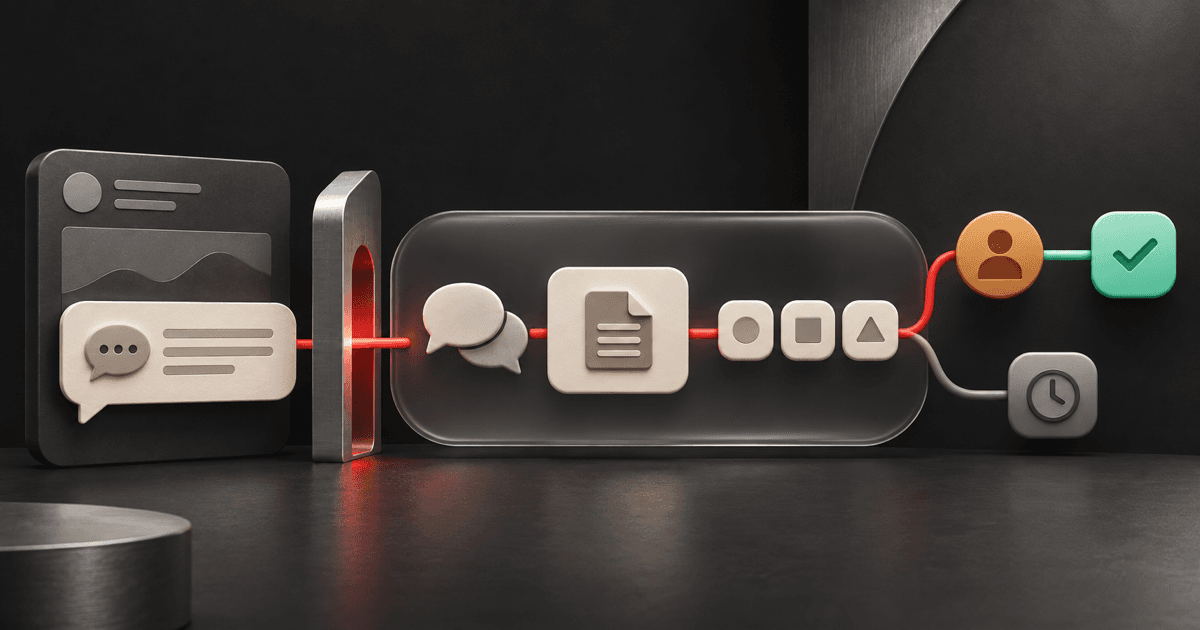
A useful comment-to-DM automation does one job: it turns a clear public request into the private conversation the post promised.
It does not treat every comment as a sales opportunity. It does not hide a ten-message campaign behind a keyword. It delivers the resource, asks one question that changes the next step, and gives every real reply an owner.
For coaches and consultants, the practical model is the CRMX PROMPT Route: Pick one post and phrase, Reply publicly, Open the private thread, Make the promised delivery, Prompt one useful choice, and Transfer the live reply.
This connects the sequence in Brent Attaway's Five Fortune Engines: earn attention consistently, make it easy for an interested person to identify themselves, follow up with immediate value, and automate only the path you have already defined.
The tactic: make one comment open one useful conversation
Start with one post that promises one specific resource.
For example:
Comment MAP and I’ll send you the one-page worksheet I use to find the bottleneck in a coaching funnel.
The comment is the trigger. The resource is the promise. The private conversation is the bridge.
The official Facebook and Instagram comment-automation documentation describes the pieces CRMX can use: a comment trigger, a public reply, an interactive private message, and a reply route for Facebook Messenger or Instagram DM. A connected social account is required, and the exact workflow still needs to be tested in the intended CRMX subaccount before activation.
The operating boundary matters: a comment proves that the person made that comment. It does not prove they are qualified, ready to buy, or inviting unrelated follow-up on every channel.
The CRMX PROMPT Route
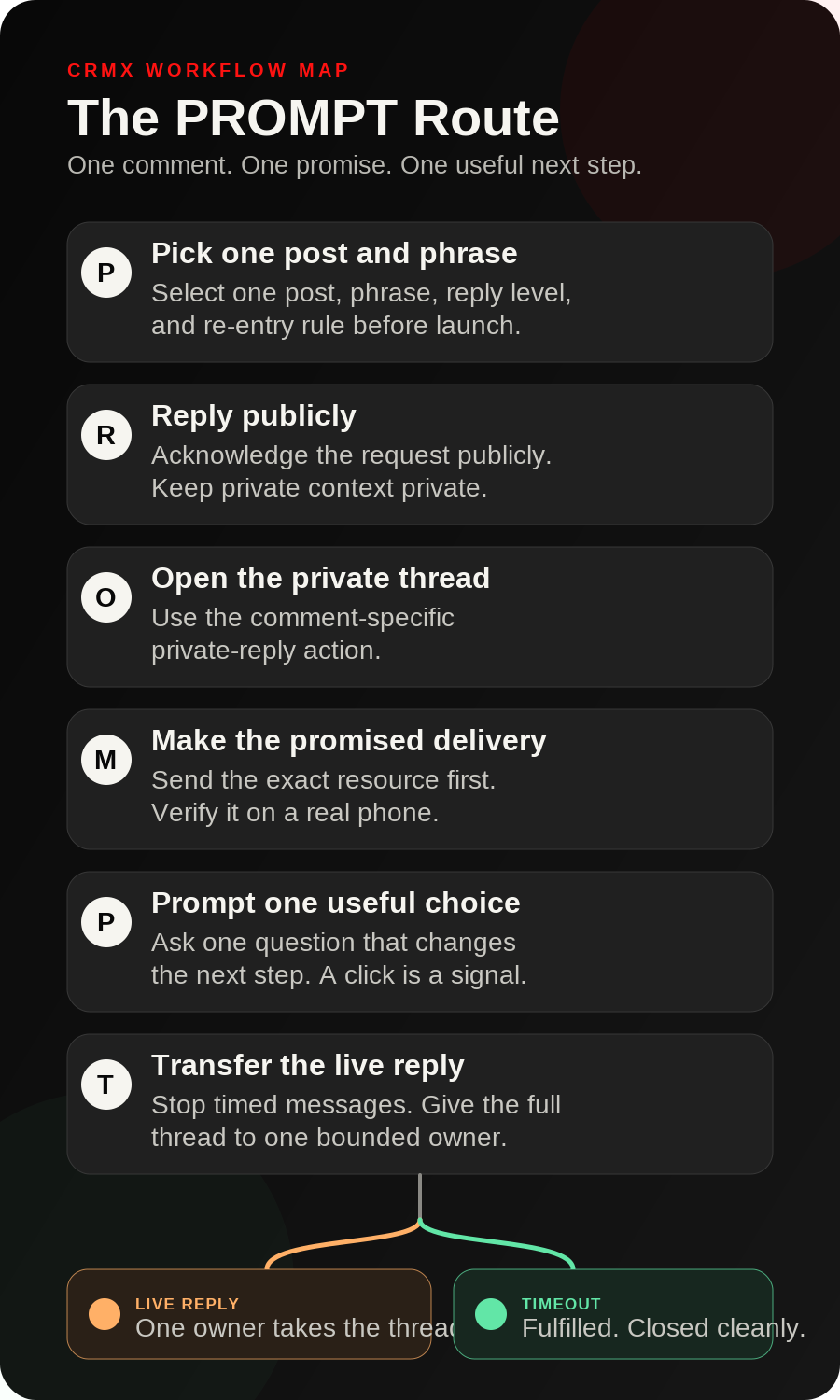
P — Pick one post and phrase
Choose the post before you build the workflow.
The current Instagram comment-trigger documentation supports selecting a connected page, a published or custom post, and an exact or contained phrase. The Facebook trigger follows the same basic pattern for a selected Facebook post.
Use a phrase that is easy to type and hard to misunderstand. Good choices name the resource or decision:
- MAP for a bottleneck map;
- AGENDA for a meeting-cost checklist;
- PLAN for a 30-day planning template;
- SCORECARD for a short assessment.
Avoid vague keywords such as YES, HELP, or INFO when they could appear in an ordinary discussion. Decide whether the trigger should match the exact comment or a phrase inside a longer comment. Also decide whether only first-level comments should qualify so a reply inside another person's thread does not enter by accident.
The post itself should set the expectation:
- what the resource is;
- who it is for;
- what it helps the reader decide;
- what to comment;
- that the resource will arrive privately.
R — Reply publicly
Use the public reply to acknowledge the request, not to qualify the person in front of everyone.
Copy-ready public reply:
I sent the worksheet privately. It includes the five-minute version and one question to help you choose where to start.
That reply confirms that something should have happened. It also gives the person a simple recovery path if the private message does not appear.
Keep the public copy neutral. Do not mention the person's private challenge, budget, readiness, health, team problem, or other context. The public thread is not the place for intake.
O — Open the private thread correctly
For an Instagram comment route, use the documented Instagram Interactive Messenger action with Reply to Comment via DM. Current Instagram DM action guidance warns against assuming that a comment alone opens an unrestricted standard-DM window. The comment-specific interactive action is the documented route for beginning the private reply.
Facebook uses the parallel Facebook Interactive Messenger action with Reply to Comment via DM. The current Facebook action documentation also notes that Meta's messaging window applies to continued automated messages.
This is why PROMPT uses two moments:
- the comment-specific action opens the private thread and fulfills the public request;
- a later private reply uses the DM-reply path and transfers the conversation based on what the person actually says or selects.
Do not build this with a generic outbound-message assumption. Match the action to the trigger and test it with a non-customer profile.
M — Make the promised delivery
Deliver the resource before turning the conversation into an intake.
Copy-ready private message:
Here’s the Bottleneck Map you asked for: [tested link]. It takes about five minutes. When you finish, which area feels most urgent: getting inquiries, booking calls, or following up after calls?
If the resource is an attachment, current Instagram Interactive Messenger documentation says quick replies cannot share that same message with the attachment. Separate the delivery and the interactive question, or use a tested link when that better fits the experience.
Verify more than the send step:
- the exact post triggers;
- the public reply appears under the correct comment;
- the private message uses the correct reply type;
- the resource link opens on a phone;
- the attachment or page matches the post's promise;
- the contact record preserves the available source context;
- a failure becomes visible to a named owner.
A workflow execution is not proof that the person received, opened, or used the resource. Record only the event you can verify.
P — Prompt one useful choice
Ask one question whose answer changes what happens next.
For a coach's worksheet, the choices might be:
- More inquiries;
- More booked calls;
- Better follow-up.
For a consultant's checklist, they might be:
- Meeting volume;
- Decision speed;
- Ownership.
Buttons or quick replies can branch a workflow, but the button is not the decision. It is one signal. The full private reply may contain a question, correction, complaint, stop request, sensitive detail, or completely different need.
Use the answer to choose one of four routes:
- deliver one relevant next resource;
- offer a tested calendar when the person has asked for a conversation and fits the defined path;
- create a human-owned conversation with context;
- close cleanly when no further action is useful.
Do not ask five questions because the interface allows it. One useful choice keeps the exchange conversational and gives the next owner enough context to respond well.
T — Transfer the live reply
A live reply changes ownership.
The first workflow handles the repeatable bridge: comment, acknowledgement, private delivery, and one routing prompt. The second workflow handles the real conversation.
When a person replies or chooses a path:
- preserve the original post, comment phrase, delivered resource, and current message;
- update the state to Intent Known or Human Conversation only when that evidence exists;
- assign or notify one owner;
- stop competing timed messages;
- let Guy answer only from approved knowledge and boundaries;
- move to booking, nurture, or a human response based on the actual context.
Copy-ready human handoff brief:
Source: Instagram post — Bottleneck Map
Requested: Bottleneck Map
Delivered: [timestamp or verified event]
Selected: Better follow-up
Latest reply: [full reply]
Owner action: Answer the question and decide whether the Follow-Up Review calendar is appropriate.
The owner should not have to reconstruct the conversation from tags.
Use six evidence-based states
Keep the operating model small enough to audit:
- Comment Captured — the selected comment trigger fired.
- Private Reply Sent — the comment-specific private-reply action executed.
- Resource Delivered — the promised file, page, or link was sent through the tested path.
- Intent Known — the person selected or wrote a usable next-step signal.
- Human Conversation — a reply requires a named person's attention or the human has taken over.
- Closed Cleanly — the promise was fulfilled and no additional action is currently justified.
Do not call the record Qualified because the contact clicked a quick reply. Do not call it Booked because a calendar link was sent. Use those states only when the corresponding evidence exists.
Build the workflow in CRMX step by step
Workflow 1: public comment to private value
- Connect and verify the intended Facebook or Instagram business account in the correct CRMX subaccount.
- Create a workflow for one platform, one page, and one selected post.
- Add the platform-specific comment trigger.
- Filter for the exact or contained phrase used in the post.
- Review the first-level-comments setting and workflow re-entry rule.
- Add one public acknowledgement with no private context.
- Add the platform-specific Interactive Messenger action using Reply to Comment via DM.
- Deliver the promised resource.
- Ask one routing question through a later message or interactive choice.
- Give the wait step a deliberate timeout.
- Send the live branch to the correct state and owner.
- Send the timeout branch to Closed Cleanly after the promise is fulfilled.
Workflow 2: private reply to owned conversation
- Start from the relevant customer-reply event for Instagram DM or Facebook Messenger.
- Narrow the route so unrelated social conversations do not enter the PROMPT workflow.
- Preserve the source post, resource, selected answer, and full latest reply.
- Stop or remove the person from incompatible timed messages.
- Route approved, simple questions to Guy only when the answer is in the knowledge base.
- Assign unclear, sensitive, sales-ready, exception, or stop-request messages to one human owner.
- Create a task only when unresolved work remains.
- Move to a calendar, later nurture, or close only after evidence supports that state.
This separation keeps a public engagement trigger from owning a conversation it no longer understands.
Two concrete use cases
Use case 1: a business coach's Instagram worksheet
A business coach publishes a short carousel about why more leads do not fix an inconsistent sales process. The post offers a one-page Bottleneck Map and asks readers to comment MAP.
PROMPT handles it like this:
- The workflow watches that post for the chosen phrase.
- The public reply says the map was sent privately.
- The private message delivers the tested worksheet link.
- A later message asks whether the current bottleneck is inquiry volume, booked calls, or post-call follow-up.
- Post-call follow-up receives one relevant article and an invitation to ask a question.
- A detailed reply about the team's process moves to the coach with the source, worksheet, selection, and full message attached.
- No reply moves to Closed Cleanly after delivery; it does not start a hidden long-term campaign.
If the person later says the timing is not right and provides a genuine future date, use a separate long-term lead nurture path. Do not manufacture that state from silence.
Use case 2: an operations consultant's Facebook checklist
An operations consultant posts a short explanation of recurring meetings that never produce a decision. The CTA says:
Comment AGENDA and I’ll send you the Meeting Cost Checklist privately.
The workflow replies publicly, sends the checklist through Facebook Interactive Messenger, and asks one choice: too many meetings, slow decisions, or unclear ownership.
- Too many meetings receives the meeting-audit worksheet.
- Slow decisions receives a short explanation of decision rights.
- Unclear ownership receives an accountability-map example.
- A free-text reply such as “Our executive team disagrees about all three” transfers to the consultant. Automation does not diagnose the organization or push a calendar without context.
- A stop request or negative reply closes the route and alerts the owner if review is needed.
The same PROMPT architecture supports both examples because the system is built around a specific promise, one useful question, and truthful state changes—not around a generic DM sequence.
Give Guy a bounded role
A trained CRMX AI employee can make this route more useful when its job is narrow.
Copy-ready role instruction:
Guy fulfills the resource promised in the selected social post, asks one approved routing question, answers only from the resource and approved company knowledge, offers the tested calendar only when the defined criteria are met, and transfers unclear, sensitive, exception, pricing, outcome, or stop-request messages to the named human owner. Guy does not infer qualification from a comment, invent advice, continue after human takeover, or start unrelated outreach.
Guy may:
- confirm which resource the person requested;
- deliver the approved link or file;
- ask one approved routing question;
- answer basic questions already covered by the resource;
- summarize the thread for the human owner;
- offer the tested calendar when the verified path calls for it.
Guy should not:
- turn a public keyword into a diagnosis;
- infer budget, authority, urgency, or fit;
- promise results, pricing, exceptions, or availability;
- continue messaging after a stop request or human takeover;
- treat silence as permission for a new campaign.
Measure the conversation, not the comment count
Track the events separately:
- qualifying comments captured;
- public acknowledgements attempted;
- private replies attempted;
- resource deliveries attempted;
- routing choices received;
- free-text replies received;
- human handoffs created;
- appointments actually booked;
- clean closes and stop requests;
- delivery, branch, ownership, and timeout failures.
Then ask better questions:
- Did the exact post and phrase trigger reliably?
- Did the private message fulfill the public promise?
- Did the routing question change the next step?
- Did live replies reach one owner without competing automation?
- Did the timeout close the route without inventing interest?
- Can the team distinguish a comment, a reply, a booking, and a real outcome?
This is where the tactic connects to the CRMX Revenue Flywheel: attention becomes a captured signal, the signal becomes a conversation, and the conversation moves only when the next state is supported by evidence.
Common failure states and repairs
| Failure | What it usually means | Repair |
|---|---|---|
| Ordinary discussion comments enter | Phrase or post filter is too broad | Use one selected post and a clearer exact or contained phrase |
| Public reply appears but no private message arrives | Wrong action, connection, trigger context, or platform restriction | Verify the connected account and use the comment-specific Interactive Messenger reply type |
| Resource arrives but the quick replies do not | Attachment and interactive-control configuration conflict | Separate resource delivery and the routing prompt, then retest |
| The same person enters repeatedly | Re-entry and nested-comment rules were not decided | Define first-level and re-entry behavior for the specific campaign |
| A live reply receives another timed message | Reply exit or ownership route failed | Stop the first workflow and hand the conversation to one owner |
| Silence starts a longer campaign | Timeout was treated as buyer intent | Fulfill the promise and close cleanly unless another valid permission and route exists |
| A calendar link is sent to everyone | The comment was mistaken for qualification | Ask one routing question and require the defined booking criteria |
| A human sees tags but not context | The handoff stores labels instead of the thread | Include source post, resource, selection, latest reply, state, and owner action |
The PROMPT launch checklist
Promise and scope
- One selected post offers one specific resource.
- The post names who the resource is for and what it helps them decide.
- The CTA explains that the resource will arrive privately.
- The trigger phrase is specific enough to avoid ordinary discussion.
- The workflow does not infer qualification, broad consent, or purchase intent from a comment.
Trigger and delivery
- The intended CRMX subaccount and social connection are verified.
- Platform, page, post, phrase, first-level setting, and re-entry rule are documented.
- The public reply contains no private context.
- The first private action uses Reply to Comment via DM.
- The resource link or attachment works on a real phone.
- Attachment and quick-reply behavior were tested in separate messages when required.
- Failed delivery becomes visible to one owner.
Routing and ownership
- One routing question changes the resource, owner, calendar, or next step.
- Free-text replies preserve the full conversation.
- Live replies stop incompatible timed messages.
- Guy has approved knowledge, booking rules, and explicit escalation boundaries.
- Human handoffs include source, request, delivery event, answer, latest reply, and owner action.
- Stop requests, complaints, sensitive details, and ambiguity have a safe route.
- The timeout fulfills the promise and closes cleanly.
Evidence and QA
- Comment, message, delivery, reply, handoff, booking, and outcome remain distinct states.
- Tests cover exact phrase, phrase inside a longer comment, wrong phrase, nested reply, repeat commenter, private reply, free-text question, stop request, no interaction, failed resource, and human takeover.
- Desktop and mobile conversation paths were tested with non-customer profiles.
- Workflow execution history and the actual social conversation were both inspected.
- The workflow is not called ready until the exact public-to-private path works end to end.
Frequently asked questions
Is a social comment permission to start a full nurture campaign?
Treat the comment as a request for the value and private reply described in the post. Do not treat it as blanket permission for unrelated channels or indefinite outreach. Continue only through a valid documented interaction, consent, or new customer signal.
Should I use an exact-match or contains-phrase trigger?
Use exact match when the keyword should stand alone. Use contains phrase when you intentionally want comments such as “Please send the MAP.” Test realistic variations and unrelated comments before publishing the workflow.
Can the first DM ask the person to book a call?
It can when the post explicitly promised that next step and the route is appropriate, but most resource CTAs should fulfill the resource first. Ask one useful question before deciding that a calendar is the next best action.
What happens when the person does not click a quick reply?
Use the default timeout deliberately. If the resource was delivered and no other valid signal exists, close the route cleanly. Silence is not a qualification event.
Can Guy run the whole conversation?
Guy can handle approved delivery, bounded questions, known answers, a tested booking path, and context-rich handoff. A person should own sensitive, ambiguous, strategic, exception, complaint, pricing, and outcome-dependent messages.
Is this the same as a lead-magnet funnel?
No. A lead-magnet funnel covers the broader asset, page, form, qualification, calendar, nurture, and measurement system. PROMPT solves the narrower social-comment-to-private-conversation handoff.
Build one bridge before you scale the campaign
Pick one post. Make one promise. Deliver it privately. Ask one useful question. Give every real reply one owner, and let silence close without pretending it means more.
Explore how CRMX supports coaches and consultants across Conversations, workflows, pipelines, calendars, forms, and reporting. If you want the exact route mapped and tested with you, request a CRMX strategy demo or review CRMX implementation services.
Sources and further reading
- HighLevel Support: Facebook and Instagram Comment Automation
- HighLevel Support: Instagram Comment(s) On A Post Trigger
- HighLevel Support: Facebook Comment(s) On A Post Trigger
- HighLevel Support: Instagram Interactive Messenger
- HighLevel Support: Instagram DM Workflow Action
- HighLevel Support: Facebook Interactive Messenger