
Networking Follow-Up for Consultants: The CRMX MOMENT Brief
Turn a promising networking conversation into contextual consultant follow-up with a named owner, due date, reply exit, and truthful next state.
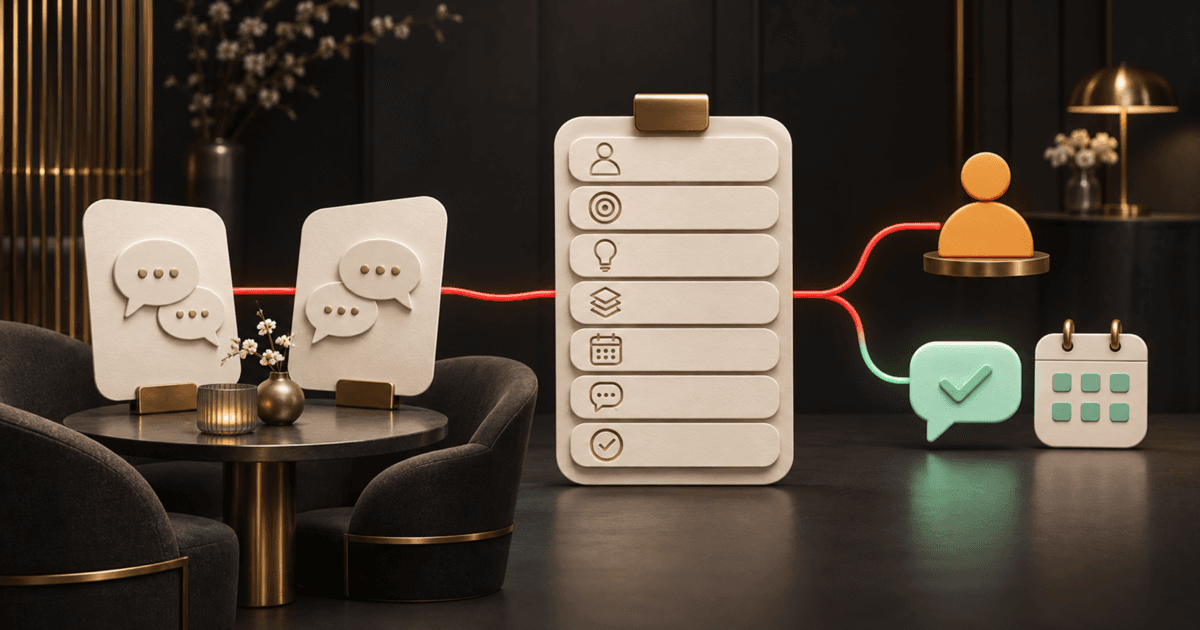
Networking follow-up for consultants works best when it continues the actual conversation: where you met, what mattered, what each person agreed to do, who owns the next move, and when it should happen.
Do not begin with a generic sequence for everyone whose badge you scanned. Begin with the promise made in the room.
The practical model is the CRMX MOMENT Brief: Meeting source, Outcome discussed, Mutual next step, Expected date, Named owner, Engagement route, and Truthful state. It turns a brief human exchange into one relevant next action without pretending every contact is a qualified sales opportunity.
That connects the engines in Brent Attaway's Five Fortune Engines: attention creates the conversation, lead capture preserves the person and context, follow-up keeps the promise moving, conversion supplies a clear next step, the relationship creates future advocacy, and automation protects the repeatable parts.
The strategy: follow the promise, not the contact
A business card, badge scan, QR submission, or new contact record answers only one question: who is this person?
Useful follow-up needs more:
- Why did the conversation matter?
- What problem, priority, or opportunity came up?
- What did you promise to send, introduce, answer, or schedule?
- Did the other person ask for that next step?
- Who should act next?
- When would the action still feel relevant?
- What state should the relationship enter after the action?
Without that context, automation can make the follow-up faster and less relevant at the same time.
For coaches and consultants, the relationship may belong in one of several systems. It could be a direct sales conversation, a future-timing path, a collaborator relationship, a referral path, a resource-only exchange, or no active follow-up at all.
The MOMENT Brief preserves that distinction before a workflow starts talking.
The CRMX MOMENT Brief
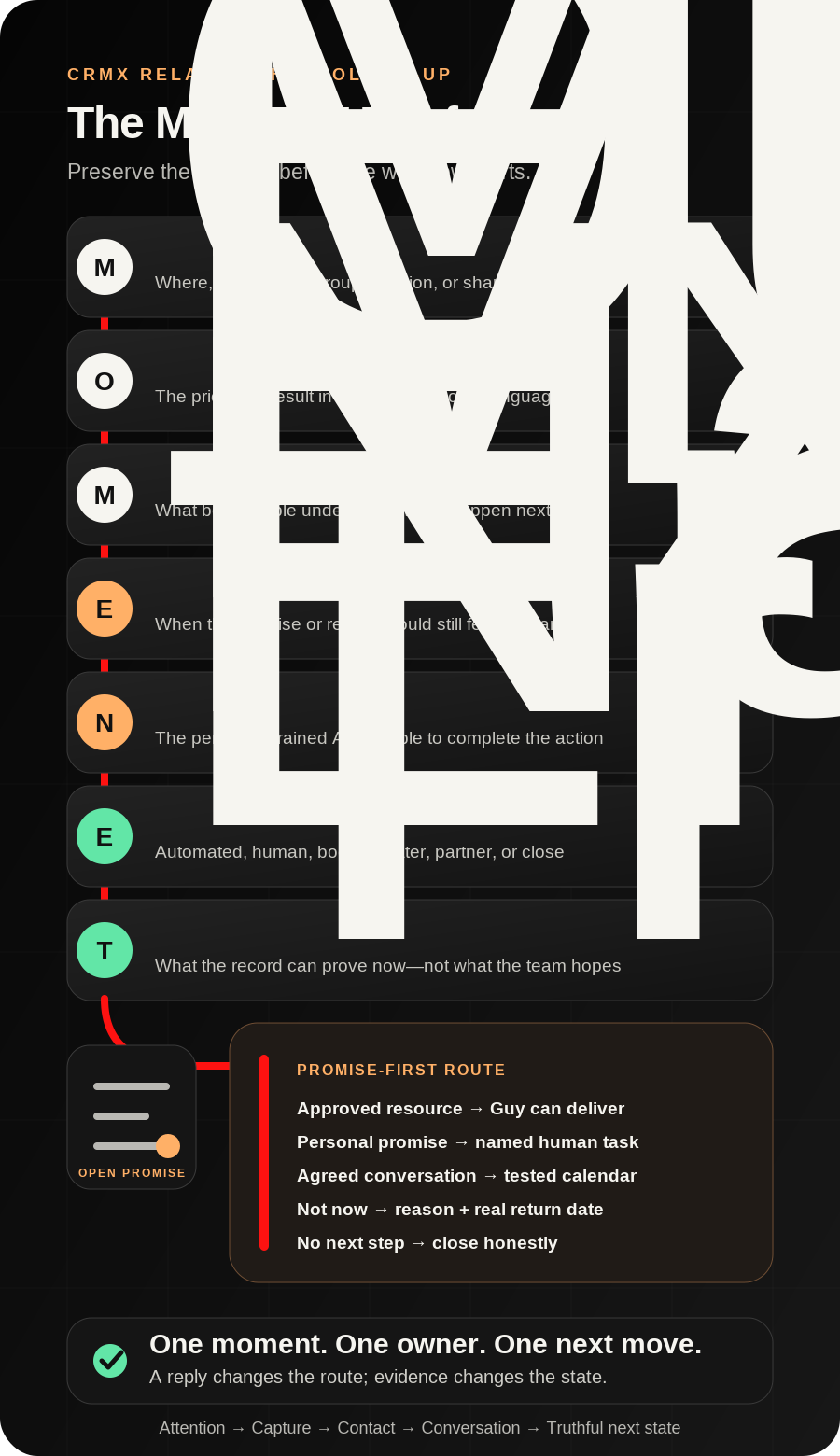
M — Meeting source
Record where the relationship began: the event, group, host, table, session, introduction, or shared context that will help both people remember the moment.
Use a specific value such as Gulf Coast Fractional Leaders Roundtable — November 2026, not simply Networking.
The source is not decoration. It gives the first message an honest opening and helps the business learn which rooms create useful conversations.
O — Outcome discussed
Capture the outcome in the other person's language.
Examples:
- clarify cash needs before hiring;
- help a leadership team make decisions faster;
- prepare managers for a reorganization;
- find a workshop speaker for a member event;
- introduce a client to a trusted specialist.
Do not turn a two-minute conversation into a diagnosis. One sentence is enough to preserve the topic and prevent the first message from becoming generic.
M — Mutual next step
Write the action both people understood.
Useful next steps include:
- send the framework mentioned in the conversation;
- make a named introduction after checking with both parties;
- answer one specific question;
- share a relevant case-neutral example;
- offer the correct consultation calendar;
- reconnect after a known planning date;
- close the loop with no further action.
If only the consultant wants the next step, it is not yet mutual. Label it as an internal review, not a promise from the contact.
E — Expected date
Give the promise a real due date.
Use the date implied by the conversation: later today, by Friday, after the board meeting, or during January planning. Translate that into one tested workflow date, task due date, or dated later state.
The current Wait action documentation supports fixed periods, specific dates, replies, contact actions, conditions, and user replies. That flexibility is useful only after the business decides what timing the promise requires.
N — Named owner
Assign the person who can actually complete the promise.
Guy may deliver an approved resource or ask a bounded routing question. A consultant may need to write the personal note. A partner manager may need to approve an introduction. An assistant may need to prepare the context, while the relationship owner still sends the final message.
The owner should be visible before the clock starts.
E — Engagement route
Choose the smallest truthful route:
- Automated delivery: the approved resource and context are already defined.
- Human promise: a personal answer, introduction, review, or tailored note is required.
- Booking path: both people agreed that a conversation is the useful next step.
- Dated later: the timing is real but not current.
- Partner or referral path: the relationship is about collaboration or a specific introduction, not a direct sale.
- No active route: the conversation was valuable, but no next action was promised.
Do not add every person to a ten-message nurture path because the event produced a list.
T — Truthful state
The record should describe what is true now:
- Captured — the person and context exist, but the next route still needs review.
- Promise Open — an action, owner, and due date are defined.
- Conversation Active — a live reply or human exchange needs attention.
- Booked — the correct appointment event exists.
- Dated Later — a legitimate reason and return date are recorded.
- Partner or Referral Path — the next work belongs in the relationship or introduction system.
- Closed Honestly — no further action is owed or appropriate.
A sent message does not make the contact Conversation Active. A task does not prove the promise was completed. A calendar link does not make the relationship Booked. Keep the state tied to evidence.
Use the promise-first decision aid
| If this is true | Route | Owner | Stop or change when |
|---|---|---|---|
| An approved resource was explicitly requested | Deliver with the meeting context | Guy or the named sender | Delivered, reply received, or exception found |
| A tailored answer or personal introduction was promised | Create a due task and internal alert | Named human | Human sends, declines, or changes the plan |
| Both people agreed to a follow-up conversation | Offer the tested calendar or send the agreed invitation | Named relationship owner | Booked, reply received, or timing changes |
| The person said “later” for a specific reason | Record the reason and real return date | Named owner | Return date changes, reply arrives, or relationship closes |
| The relationship concerns a partner or referral | Move to the dedicated partner or introduction route | Partner or referral owner | Introduction accepted, declined, completed, or deferred |
| No next action was promised | Close honestly | Record owner | New inbound signal creates a new reason to act |
This table is a CRMX operating recommendation, not a claim that the platform can infer relationship intent on its own.
Capture context without making the event awkward
Use the least intrusive capture method that preserves the promise.
Option 1: the consultant records the MOMENT Brief
After the conversation, the consultant or assistant enters the contact and the seven fields. This is appropriate when the other person has already provided their details and the promised action is personal.
Option 2: a short shared form
When a resource or event follow-up is part of the experience, a short CRMX form can capture contact details and one or two context fields. Current contact-form documentation supports standard and custom fields, direct links, embeds, and workflow connections.
The current forms Integrate documentation also describes a Share path with a downloadable QR code. If you use it, test the published form and the exact follow-up route on a real phone before the event.
Do not make the other person complete a full application to receive a promised one-page resource.
Option 3: a human note followed by verified entry
For a fast conversation, capture a private shorthand note and enter the structured MOMENT fields later that day. The workflow should begin only after someone verifies the context and route.
This prevents a rushed note such as “send deck” from becoming an automated promise to the wrong person.
Build the networking follow-up system in CRMX
1. Create the seven MOMENT fields
Use stable fields for:
- meeting source;
- outcome discussed;
- mutual next step;
- expected date;
- named owner;
- engagement route;
- truthful state.
Add a brief context note when useful, but do not hide routing data inside one long free-text field.
2. Define the entry events
Choose only the events that should start the system:
- the dedicated networking form was submitted;
- a verified contact was added with the MOMENT route ready;
- the named owner marked the brief ready for follow-up.
The Form Submitted trigger can start a filtered workflow after the selected form is completed. Test duplicate submissions and incomplete context before publishing the route.
3. Separate automated and human promises
An approved resource delivery can be consistent. A tailored recommendation, personal introduction, or judgment-heavy answer should remain human-owned.
The current Add Task action can create an assigned task with a due value and description. Put the meeting source, outcome, promised action, expected date, and relevant record link in the task.
Use an internal notification for visibility, but do not confuse the alert with completion. The truthful state stays Promise Open until the evidence changes.
4. Send the first message from the brief
The message should sound like a continuation, not a campaign.
Requested resource
Good meeting you at the leadership roundtable. You mentioned the team is trying to make decision ownership clearer before January planning. Here is the one-page decision map I offered. If you want, reply with the step that keeps stalling and I will point you to the relevant section.
Agreed follow-up conversation
I enjoyed our conversation at the chamber breakfast about preparing managers for the reorganization. You suggested a short working session next week. Here is the calendar we discussed. If another time or owner would make more sense, reply here and I will adjust the route.
Human-owned introduction
I have the introduction we discussed on my list. I am checking the context with both sides first so the note is useful. I will close the loop by Thursday, even if the answer is that the timing is not right.
Use these as structures, not universal scripts. The real context and promise should change the words.
5. Make replies interrupt the timer
The Customer Replied trigger can route supported inbound replies by filters such as channel, tag, phrase, intent, or originating workflow.
When a reply arrives:
- stop incompatible timed messages;
- set the state to Conversation Active;
- assign or confirm the named owner;
- preserve the reply with the MOMENT context;
- create the next human action when judgment is required.
Guy may acknowledge the message and ask one approved question. He should not talk over the live relationship or keep sending a sequence after the consultant takes ownership.
6. Protect the opportunity pipeline
Not every networking contact deserves an opportunity.
Define the rule first. For example, create or update an opportunity only when the person has asked about a defined service, agreed to a relevant sales conversation, or reached another business-approved threshold.
The Find Opportunity action can look for an existing matching opportunity and branch when none is found. The Update Opportunity action can update the referenced record after the correct opportunity context exists.
Use those controls to avoid duplicates. Do not use them to pretend the software knows whether the relationship is commercially real.
7. Connect the correct next system
- A direct buyer conversation can move to qualification and the correct calendar.
- A genuine not-now relationship can move into the long-term lead nurture path with a real reason and return date.
- A formal partner introduction belongs in the referral-partner relay.
- A new inbound question belongs in the separate coaching inquiry follow-up route.
- A closed relationship should leave the active queue instead of receiving irrelevant follow-up.
That is how the MOMENT Brief joins the wider CRMX Revenue Flywheel without forcing every contact through the same path.
Use case 1: a fractional CFO at an industry roundtable
A fractional CFO meets an agency owner during a finance roundtable. The owner is considering two hires but cannot see how the timing affects cash needs.
The conversation produces one mutual next step: the CFO will send a simple hiring-cash worksheet the next morning. If it surfaces a planning question, the owner may book a 25-minute review.
The MOMENT Brief records:
- Meeting source: November agency finance roundtable;
- Outcome discussed: compare the cash effect of two hiring sequences;
- Mutual next step: send the approved worksheet and invite one reply;
- Expected date: next business morning;
- Named owner: fractional CFO;
- Engagement route: automated resource delivery with human reply ownership;
- Truthful state: Promise Open.
Guy sends the approved resource with the meeting context. A reply changes the state to Conversation Active and routes the full thread to the CFO. No reply can lead to one bounded reminder or an honest close, according to the business's rule. The system does not label the owner qualified, estimate a cash result, or create a proposal from the badge scan.
Use case 2: a leadership coach at a chamber breakfast
A leadership coach speaks with a people-operations director whose managers are preparing for a reorganization. They agree that the coach will send a manager-conversation checklist and that the director will decide after an internal meeting whether a working session would help.
The MOMENT Brief records:
- Meeting source: local chamber leadership breakfast;
- Outcome discussed: help managers handle role-change conversations consistently;
- Mutual next step: send the checklist, then reconnect after the internal meeting;
- Expected date: checklist today; return date two business days after the meeting;
- Named owner: leadership coach;
- Engagement route: resource delivery followed by a dated-later path;
- Truthful state: Promise Open, then Dated Later after delivery.
Guy can deliver the checklist and preserve the return date. The coach owns any sensitive organizational question. If the director replies early, the later timer stops. If the meeting moves, the return date changes. A calendar invitation appears only when a working session becomes the mutual next step.
Give Guy a bounded relationship role
A trained CRMX AI employee can protect the promise without pretending to own the relationship.
Guy may:
- reference the verified meeting source and approved outcome summary;
- deliver an approved resource;
- ask one approved routing question;
- offer the tested calendar that matches the agreed next step;
- acknowledge a reply and preserve its context;
- update allowed MOMENT fields;
- route an exception to the named person;
- summarize overdue promises for review.
Guy should not:
- invent something that happened in the conversation;
- infer fit, budget, authority, or urgency;
- treat every contact as a lead or opportunity;
- promise an introduction before both sides are ready;
- give advice beyond approved knowledge;
- send a personal message the consultant promised to write;
- decide that silence means rejection;
- keep messaging after a human takes ownership;
- mark a resource delivered, conversation active, appointment booked, or introduction completed without the required evidence.
Guy keeps the context moving. The human relationship owner keeps the judgment.
Measure whether promises move
Do not judge the system by contacts added or messages sent alone.
Start with five operating measures:
- Brief completeness: eligible records with all seven MOMENT fields usable.
- Open-promise ownership: Promise Open records with a named owner and due date.
- Promise evidence: due promises with the required delivery, human send, or completion evidence.
- Reply ownership: live replies with a named person and current next action.
- Truth-state coverage: records in a real state instead of a generic networking tag.
Then inspect outcomes separately: conversations, bookings, dated-later paths, partner or referral routes, and honest closes.
A completed task is task evidence. A sent email is send evidence. A reply is conversation evidence. A booking is appointment evidence. Keep those layers separate so a clean dashboard does not hide a broken relationship handoff.
MOMENT launch checklist
Context and routing
- The capture path records a specific meeting source.
- The outcome summary uses the other person's stated context without inventing a diagnosis.
- The mutual next step distinguishes agreement from the consultant's internal hope.
- Every open promise has a date and named owner.
- Automated, human, booking, later, partner, referral, and closed routes are separate.
- Opportunity creation has a written business threshold.
Workflow and ownership
- The selected form or verified-entry event starts the intended workflow.
- Duplicate form submissions and existing opportunities have tested paths.
- Human-owned promises create a due task with usable context.
- Notifications point to the record but do not mark the promise complete.
- Replies stop incompatible messages and expose the live conversation.
- Guy's approved knowledge, questions, calendar, and escalation rules are tested.
- Timed-out promises enter a visible exception queue.
Evidence and experience
- One known record is tested through each route.
- The published mobile capture path and QR code are tested on a real phone.
- Resource links, calendars, owners, dates, and merge fields are reopened and verified.
- A send, task, stage, or tag is not presented as a reply or outcome.
- The first message names the real context and promised next step.
- No sequence keeps running after a live human conversation takes over.
Frequently asked questions
How soon should a consultant follow up after networking?
Follow the timing of the promise. A resource offered today should not wait for a generic weekly sequence. A future planning conversation should not receive an artificial urgent pitch. Record the expected date, owner, and evidence for the actual next step.
Should I add every networking contact to my CRM?
Only when the record supports a legitimate business purpose and your process allows it. Even then, classify the relationship honestly. A contact record does not automatically belong in a sales pipeline or nurture sequence.
Should I use a QR code at an event?
Use one when it makes the promised exchange easier. Keep the form short, explain what the person will receive, test the mobile path, and provide a human fallback. A QR code should support the conversation, not replace it.
Can Guy write every networking follow-up message?
Guy can prepare or send approved, context-based messages for defined routes. Personal introductions, sensitive advice, tailored recommendations, and relationship promises should stay with the named human unless the business has deliberately trained and tested a narrow role.
Is a networking contact the same as a qualified lead?
No. Qualification requires the business's defined evidence. A conversation may produce a resource exchange, collaboration, referral, future date, or no active next step without becoming a sales opportunity.
Turn the moment into an owned next move
The best networking follow-up does not prove how automated your business is. It proves that you listened.
Start with one event, one short MOMENT Brief, one promise-first routing table, and one visible exception queue. Test the first message, reply exit, human handoff, calendar, and truthful close before expanding the system.
Explore the complete CRMX system for coaches and consultants and see how forms, Conversations, workflows, pipelines, calendars, websites, and reporting connect on the CRMX platform. If you want CRMX to build the MOMENT Brief around your real relationship process, explore implementation services or request a live strategy demo.
Sources and further reading
- Official Support: Create a Contact Form
- Official Support: Integrate Forms, Surveys, and Quizzes
- Official Support: Form Submitted Workflow Trigger
- Official Support: Customer Replied Workflow Trigger
- Official Support: Workflow Wait Action
- Official Support: Add Task Workflow Action
- Official Support: Internal Notification Workflow Action
- Official Support: Find Opportunity Workflow Action
- Official Support: Update Opportunity Workflow Action