
Referral Partner Follow-Up for Coaches and Consultants: The CRMX PACT Relay
Build a referral-partner follow-up system that defines the introduction, captures context, and gives both relationship paths an owner.
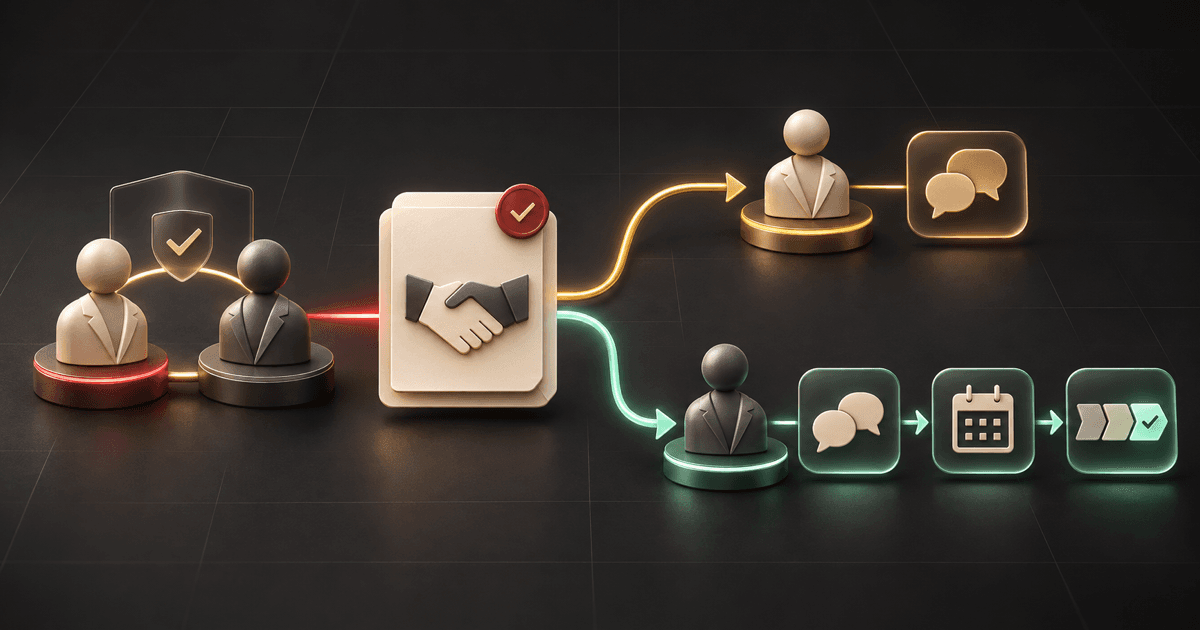
A referral-partner follow-up system for coaches and consultants should manage two relationships without confusing them.
The partner needs a clear definition of a useful introduction, an easy asset to share, a relationship owner, and a real next review date. The referred person needs to choose whether to enter the conversation, see why the next step is relevant, receive a prompt response, and know who owns it.
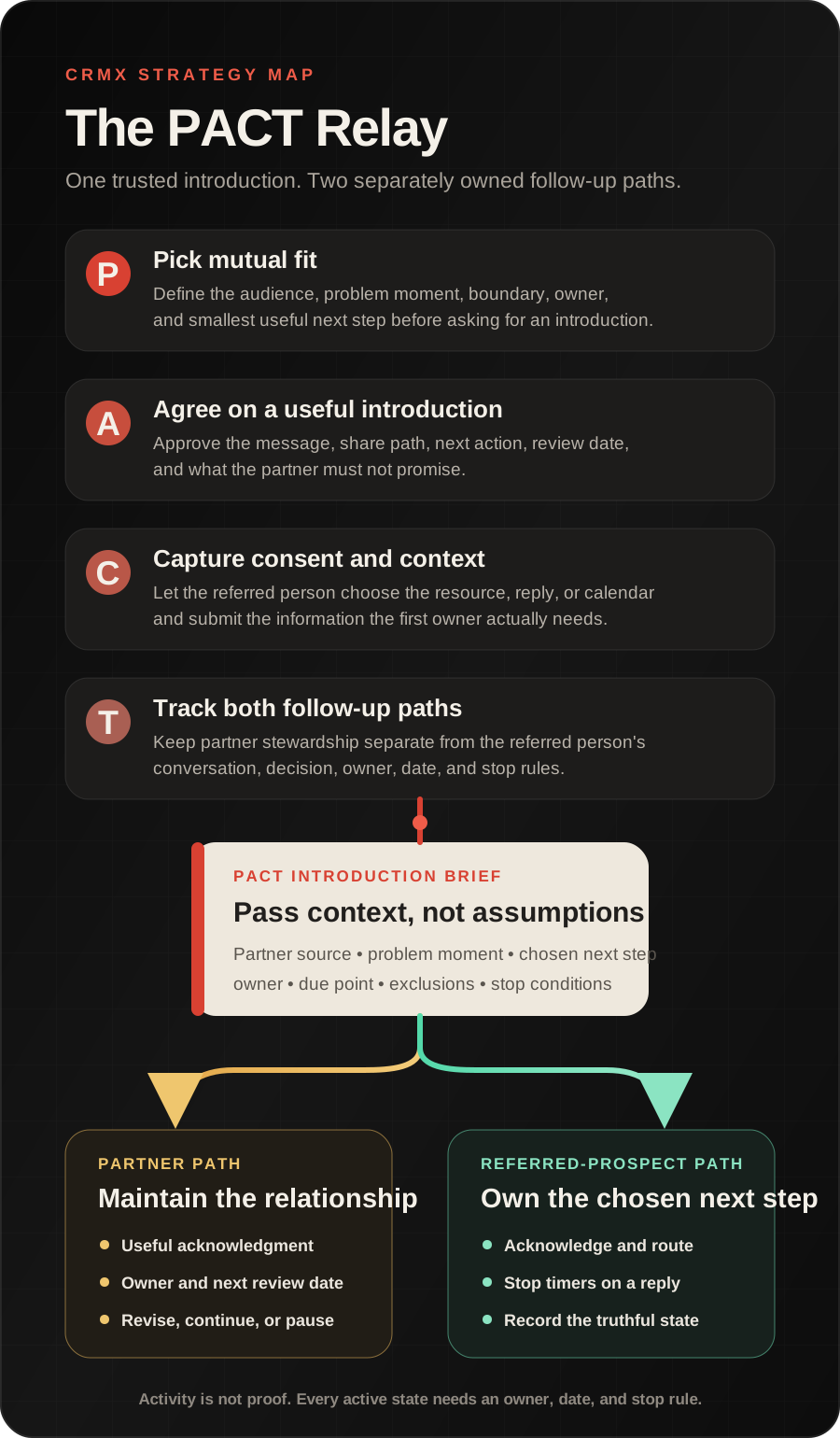
The CRMX PACT Relay turns that into four operating moves: Pick mutual fit, Agree on a useful introduction, Capture consent and context, Track both follow-up paths.
That is the useful pattern now: define the channel before the lead arrives, let the referred person raise their own hand, carry the partner context into CRMX, interrupt automation when a real reply appears, and keep the partner relationship separate from the prospect's private sales conversation.
Brent Attaway's Five Fortune Engines connects attention, lead capture, follow-up, conversion, raving fans, and automation as one operating system. A referral partner can extend trusted attention. A shareable path can capture the resulting interest. Follow-up can turn the opt-in into a conversation. Conversion can give that conversation a repeatable next step. A strong experience can create future introductions. Automation can keep the handoffs consistent while people keep judgment.
The strategy: one introduction creates two follow-up paths
Many referral systems collapse three different events into one vague note:
- a partner believes someone may be a fit;
- the person chooses to learn more;
- the person decides what to do next.
Those are not the same state.
A partner mentioning a name is not a captured lead. A referred person submitting a form is not automatically qualified. A booked call is not a sale. A thank-you message to the partner is not permission to share what happened in the prospect's conversation.
The PACT Relay preserves the distinction:
- the partner path tracks fit, introduction language, approved assets, relationship owner, last useful touch, next review date, and pause conditions;
- the referred-prospect path tracks the person's own submission, source context, first response, conversation owner, booking or resource route, live replies, decision state, and stop conditions;
- the relay passes only the context needed to make the next conversation useful.
That separation is what keeps a warm channel from becoming a pile of names, duplicate opportunities, generic check-ins, and awkward requests for updates.
The CRMX PACT Relay
P - Pick mutual fit
Do not begin with, “Who do you know?”
Begin with a useful fit statement. Define the person, problem, moment, and next step your partner can recognize without pretending to qualify on your behalf.
A practical fit statement answers:
- Who is the person or business?
- What observable situation makes the conversation relevant?
- What problem can the coach or consultant help examine?
- What should the partner avoid promising?
- What is the smallest useful next step?
- What is clearly outside the fit?
For example:
A founder with a growing leadership team who can no longer keep priorities, accountability, and weekly execution visible. The next step is a short operating-rhythm diagnostic, not a promise that coaching will fix the business.
The statement should be narrow enough to guide a real introduction and broad enough that the partner does not need to act like a salesperson.
Record the partner's audience, common problem, approved offer language, exclusions, relationship owner, and review date in CRMX. Use a tag or pipeline state only if your team knows what that value means and maintains it.
Useful partner states might be:
- Fit Review - the relationship may be useful, but no introduction path has been agreed.
- PACT Defined - audience, problem, language, handoff, and owner are documented.
- Active Partner - the share path is available and the next relationship date is known.
- Review Due - the fit, asset, owner, or next date needs a human review.
- Paused - no outreach or introduction request should continue until a named condition changes.
Do not equate a networking meeting, signed partner agreement, tag, or pipeline stage with an active referral relationship. The state is useful only when it describes what the team can do next.
A - Agree on a useful introduction
The introduction should make the referred person's first decision easier, not make the partner write a sales pitch.
Create a one-page partner asset or shareable CRMX website or funnel with:
- one recognizable problem;
- one useful resource or diagnostic;
- one sentence about who it is for;
- one sentence about what happens after submission;
- the optional next step;
- a short form that asks only for decision-changing context.
Then document the PACT introduction brief:
Partner: [Name / Organization]
Audience: [Who they can recognize]
Problem moment: [Observable situation]
Approved promise: [What the resource or conversation will help examine]
Do not promise: [Outcome, qualification, terms, or advice boundary]
Share path: [Approved page, form, or resource]
Prospect next step: [Resource, reply, diagnostic, or calendar]
Partner owner: [Human owner]
Prospect owner: [Human or bounded Guy role]
Partner review date: [Date or event]
Pause conditions: [What stops the path]
The brief is an operating contract, not a public promise. It gives the relationship enough structure to be repeatable without turning the partner into an unpaid appointment setter.
C - Capture consent and context
The cleanest introduction path lets the referred person submit their own information.
A partner can share the approved page, resource, or event invitation. The referred person decides whether to use it. The form records the partner source and asks only what the first useful route needs.
The current Form Submitted workflow documentation supports starting a workflow when a selected CRM form is submitted. Use a dedicated partner path or a reliable hidden/source value so the record preserves which partner and offer created the introduction.
A compact form might ask:
- name and preferred contact method;
- the problem or decision they want help examining;
- the current stage or timing;
- whether they want the resource, a reply, or the relevant conversation;
- anything the first owner should know.
Do not ask the partner to complete a long qualification form about someone else. Do not move assumptions into the contact record as facts. Do not promise that a referral receives priority, acceptance, a result, or a commercial offer.
After submission, CRMX can:
- apply the verified partner source;
- acknowledge the person's selected next step;
- find or create the correct open opportunity;
- assign the conversation owner;
- create a task or internal notification when human review is needed;
- deliver the approved resource or calendar;
- stop timed messages when a live reply arrives;
- record the next truthful state.
That is a stronger handoff than “Tell them I sent you,” because the source context and the person's own request arrive together.
T - Track both follow-up paths
The partner and the prospect should not share one timer, one pipeline, or one definition of success.
Partner path
Track:
- PACT status;
- partner owner;
- approved share path;
- last useful relationship touch;
- next review date;
- asset or fit change needed;
- acknowledgment due;
- paused or closed reason.
The partner's next step may be a useful asset, an event invitation, a joint teaching idea, an audience-fit review, or a simple thank-you after an introduction. It should not be a demand for another name.
Referred-prospect path
Track:
- form-submission event;
- partner source;
- selected resource or conversation;
- problem context in the person's own words;
- assigned owner;
- acknowledgment state;
- reply or booking state;
- next decision and date;
- later, closed, or handed-off outcome.
The current Customer Replied trigger documentation supports starting a workflow when a contact replies and filtering the event by items such as originating workflow, tag, phrase, intent, and channel. Use the reply to stop the timed path, route the live conversation, and alert the correct owner.
Do not let a keyword decide that the person is qualified or ready to buy. A reply such as “yes” could mean yes to the resource, yes to a question, or yes to a calendar link. The conversation and record still matter.
If your team uses a delivered reply from a person inside CRMX Conversations as proof of human follow-through, the current User Replied trigger documentation distinguishes that event from workflow and Conversation AI messages. Assignment, task creation, an internal alert, and a Guy acknowledgment are not evidence that the named human answered.
Build the PACT Relay in CRMX
1. Start with one partner type and one next step
Choose one relationship where the audience, problem, and next action are already understandable.
Map:
- partner type;
- person or company they serve;
- recognizable problem moment;
- approved resource or diagnostic;
- form and source value;
- partner owner;
- prospect owner;
- first prospect response;
- next relationship review;
- stop conditions.
Do not begin with every networking contact, every offer, and every calendar. One complete relay is easier to test than a generic “partner program” with no operating truth.
2. Build the partner record
Use contact fields for durable relationship facts. Use an opportunity or partner pipeline when the relationship needs its own stages, owner, dates, and reporting.
Minimum partner fields:
- Partner Type
- Partner Audience
- Problem Moment
- Approved Introduction Language
- Share Path
- Partner Owner
- PACT Status
- Last Useful Touch
- Next Partner Review Date
- Pause Reason
The record should tell a team member what the partnership is for and what happens next without opening a private note thread.
3. Build the share page and form
Keep the page specific. Use the same problem language the partner agreed to share. Explain what the person will receive and what happens after the form.
The form should preserve:
- partner source;
- offer or resource path;
- the referred person's own problem language;
- chosen next step;
- contact method;
- any routing field the owner truly needs.
This is the referral equivalent of a focused lead magnet funnel for coaches: one useful decision, one clear capture path, and one truthful next route.
4. Build the referred-prospect workflow
Use the selected form as the entry event.
Then:
- write the partner source to the contact record;
- send the approved acknowledgment;
- deliver the selected resource or relevant calendar;
- find the correct open opportunity or take a not-found branch;
- assign the conversation owner;
- notify or task a human when the request needs judgment;
- stop timed messages on reply, booking, human takeover, decline, or close;
- move the opportunity only when the next state is known.
The Find Opportunity action can return one configured earliest or latest opportunity that matches all filters, with a separate not-found path. When a contact can have several programs, projects, or offers, a returned match is not proof that it is the right one. Use narrow filters and test duplicates.
The Update Opportunity action can update the opportunity that supplied context or the opportunity supplied by a correct find step. A stage move should describe the route. It should not claim that a conversation happened, the person is qualified, a proposal was accepted, or a result was achieved.
5. Build the partner follow-up workflow separately
The partner path should not wait on the prospect's sales outcome.
Use events the relationship owner can verify:
- PACT brief approved;
- share asset updated;
- introduction received;
- acknowledgment sent;
- partner review date reached;
- fit changed;
- owner changed;
- path paused.
A partner acknowledgment can say that the introduction was received and owned. It should not disclose the referred person's questions, fit assessment, scope, price, decision, or private conversation.
Create a human review task before the next relationship touch when the fit, asset, promise, or owner may have changed. The current Add Task workflow documentation supports a task title, description, assignee, due interval, optional due time, and weekend handling.
A created task is evidence that work was assigned. It is not evidence that the partner relationship was reviewed or that anyone followed through.
6. Notify with a complete introduction brief
When human review is required, send one concise internal notification:
PACT introduction received
Partner: [Partner Name]
Referred person requested: [Resource / Reply / Conversation]
Problem context: [Person's Own Words]
Source path: [Page / Offer]
Prospect owner: [Owner]
First action due: [Date / Time]
Record: [Approved Record Link]
The documented Internal Notification action can alert selected users, roles, or teams through supported internal channels. Test the exact workflow context so every dynamic value resolves correctly.
An alert proves that the notification step ran. It does not prove that the owner accepted the handoff, replied, or completed the task.
7. Give Guy a bounded role
Guy can serve as a trained CRMX AI employee for the repeatable part of the prospect path.
Guy may:
- acknowledge the form submission;
- deliver the approved resource;
- ask one approved routing question;
- answer approved logistics;
- offer the correct calendar when the route is known;
- recognize a request for a person;
- summarize verified context for the human owner;
- stop and hand off on an exception.
Guy should not:
- decide whether the partnership is mutually valuable;
- promise reciprocal referrals;
- infer qualification from the partner's reputation;
- provide unapproved professional advice;
- negotiate scope, price, terms, or guarantees;
- tell the partner what the prospect discussed or decided;
- treat a booked call as a commercial outcome.
The partner relationship stays human-owned. Guy makes the defined first mile more consistent.
8. Test the relay, not just the messages
Use test records for:
- a first-time referred person;
- an existing contact with no open opportunity;
- an existing contact with one correct open opportunity;
- a contact with several possible opportunities;
- an incomplete submission;
- a reply before the timed acknowledgment finishes;
- a request for a human;
- a booking;
- a not-now decision with a real date;
- a decline or do-not-continue request;
- a paused partner;
- a changed partner owner;
- missing partner source data;
- unresolved notification values.
Verify the trigger, record, source, owner, task, notification, conversation, stop rule, stage, and reporting state for each case. A published workflow is not proof that the complete relay works.
The PACT state-and-owner decision aid
| Visible state | What is true | Owner | Next action | What must not happen |
|---|---|---|---|---|
| Fit Review | A possible partner relationship exists | Relationship owner | Define audience, problem, and next step | Ask for introductions |
| PACT Defined | The introduction brief is approved | Relationship owner | Build and test the share path | Promise outcomes or reciprocity |
| Active Partner | Share path and review date are current | Relationship owner | Maintain the useful relationship | Send generic “any referrals?” chasers |
| Review Due | Fit, asset, owner, or date needs review | Relationship owner | Accept, revise, or pause | Keep using stale language |
| Prospect Submitted | The person chose a next step | Prospect owner | Acknowledge and route | Treat the partner's opinion as qualification |
| Prospect Reply Active | The person replied | Conversation owner | Stop timers and respond | Continue generic nurture over the reply |
| Human Review Due | Judgment is required | Named human | Review context and answer | Let Guy decide scope, fit, or terms |
| Later with Date | The person chose a real future point | Prospect owner | Close the short path and set the date | Keep checking in without a reason |
| Closed or Handed Off | The route ended or moved to the next system | Named owner | Record the outcome and stop obsolete steps | Keep both paths open by default |
Use case 1: a business coach and fractional CFO
A business coach and a fractional CFO serve some of the same founder audience, but they solve different problems.
They define a PACT brief around one observable moment: the founder's team is growing, but weekly priorities, decision ownership, and execution are no longer visible. The coach creates a short operating-rhythm diagnostic page. The CFO shares it when the problem appears in a planning conversation.
The founder submits the form and chooses one of two next steps: receive the diagnostic worksheet or discuss the operating rhythm. CRMX records the CFO as the partner source, delivers the selected path, and assigns the coach's conversation owner.
If the founder replies, timed messages stop. If the founder asks about scope or fit, a human task and notification start. If the founder chooses later, the short path closes into a dated long-term follow-up route.
The CFO receives a simple acknowledgment that the introduction reached an owner. The coach does not send the founder's answers, fit decision, or buying state back through the partner path.
Use case 2: a leadership consultant and HR advisory firm
A leadership consultant and an HR advisory firm define a different problem moment: a manager group has grown, but one-on-ones, expectations, and escalation decisions vary by team.
The partner share path offers a manager operating-rhythm brief and an optional leadership diagnostic conversation. The form asks the referred leader which management moment is creating the most friction and whether they want the brief or a conversation.
CRMX preserves the HR firm as the source, sends the selected asset, and routes the conversation. Guy can answer approved scheduling questions and offer the correct calendar. The consultant owns any diagnosis, recommendation, scope, or commercial discussion.
After a verified discovery conversation, the prospect moves into the separate discovery-call follow-up workflow. The partner relationship remains on its own review rhythm, with an updated asset or joint teaching idea as the next useful touch.
Copy-ready PACT messages
Partner invitation
I think we serve some of the same people at different moments. I drafted a one-page fit statement and a simple resource your clients can choose to use when [problem moment] appears. Want to review the audience, language, handoff, and boundaries together before either of us shares it?
Partner share note
You mentioned [problem moment]. [Name / Company] created this short [resource or diagnostic] to help you examine it. If it is useful, you can choose the resource or a conversation here: [Share Path]. You will be telling them directly what you want next.
Referred-person acknowledgment
Thanks for requesting [resource or next step] through [Partner Name]'s introduction. I have your note about [problem in the person's own words]. [Approved next action] is next. If you reply here, the right person will see the conversation.
Human handoff
I have your question and the context you shared. [Human Owner] needs to review this rather than have me guess. I have routed it with your selected next step and will stop the timed messages here.
Partner receipt
Thank you for making the introduction. The request reached the correct CRMX path and has an owner. I will keep their conversation private, and I will follow up with you separately on our next partner review date.
Partner review
Before we keep using this path, I want to make sure the audience, problem, resource, and handoff still fit what you are seeing. Is the current brief still useful, or should we revise or pause it?
Measure the relay without inventing attribution
Track state movement separately for each path.
Partner-path measures
- PACT briefs defined and currently approved;
- active partners with a named owner and review date;
- partner reviews completed, revised, or paused;
- share assets that need updates;
- introductions acknowledged;
- partner relationships with no valid next date.
Referred-prospect measures
- partner-source submissions;
- selected resource, reply, or conversation routes;
- acknowledgments sent;
- replies routed;
- human reviews created and completed through the defined proof;
- appointments booked and held as separate states;
- later-with-date, closed, and handed-off outcomes;
- duplicate or missing-opportunity exceptions.
Do not claim that a partner caused revenue merely because the source field exists. Do not credit a workflow with a relationship result because a message was delivered. Use the reports to find missing ownership, stale states, and broken handoffs.
The larger CRMX Revenue Flywheel can then connect partner attention to captured context, first contact, qualification, booking, show-up, conversion, reactivation, and a future raving-fan path without forcing one metric to stand in for the whole journey.
The PACT build-and-QA checklist
Partner strategy
- □ One partner type and one recognizable problem moment are defined.
- □ The partner audience and exclusions are written in plain language.
- □ The approved promise does not guarantee an outcome or commercial decision.
- □ Partner owner, last useful touch, next review date, and pause condition exist.
- □ The share asset gives the referred person a choice rather than asking the partner to transfer assumptions.
CRMX build
- □ The partner source is preserved on the contact or correct opportunity.
- □ The selected form starts only the intended workflow.
- □ Existing-contact and duplicate-opportunity branches are tested.
- □ Prospect acknowledgment matches the selected next step.
- □ Tasks and internal notifications contain enough context to act.
- □ Reply, booking, human takeover, later, decline, and close exits stop obsolete messages.
- □ Partner and prospect states have separate owners and dates.
- □ Guy's knowledge, questions, calendars, and escalation boundaries are approved.
Evidence and privacy boundaries
- □ A task is not counted as a completed response.
- □ A notification is not counted as accepted ownership.
- □ A booking is not counted as a sale or qualified fit.
- □ A Guy acknowledgment is not counted as human judgment.
- □ Partner reporting does not expose the referred person's private conversation or commercial outcome.
- □ Test records prove both paths and every stop condition.
- □ The workflow is published only after the exact form, fields, owners, calendars, stages, and messages pass QA.
Frequently asked questions
Is a referral partner the same as a customer referral source?
Not necessarily. A customer referral often begins from one completed customer relationship. A professional referral partner is an ongoing relationship with a defined audience, problem, share path, owner, and review rhythm. Keep both models explicit instead of mixing them under one tag.
Should a partner submit the referred person's contact information?
The PACT Relay recommends a share path that lets the referred person submit their own information and choose the next step. If your business uses another introduction method, define and review its operational, privacy, and legal requirements before launch.
Should every partner introduction create a new opportunity?
No. First check whether the contact and correct opportunity already exist. Use narrow matching rules and a not-found branch. When several engagements could match, send the decision to a person rather than update the wrong record.
Can Guy qualify every referred prospect?
Guy can ask approved routing questions and handle the defined first mile. A human should own fit, diagnosis, regulated advice, scope, pricing, terms, guarantees, and exceptions.
What should the partner be told after the introduction?
Confirm that the introduction reached the correct path and has an owner. Keep the prospect's conversation, fit assessment, scope, price, decision, and outcome private unless the prospect has explicitly authorized the business to share specific information through an approved process.
How often should the business follow up with a referral partner?
Use a real relationship event or agreed review date rather than a universal cadence. Review fit when the audience, problem, offer, asset, owner, or partner context changes. Pause the path when no useful next step exists.
Build a referral channel that can keep its promises
A strong referral-partner system does not squeeze more names from a relationship. It makes one useful introduction easy to recognize, easy to choose, easy to route, and easy to own.
The PACT Relay gives the partner a clear lane, gives the referred person control of the next step, gives your team the context it needs, and gives automation a process worth repeating.
See how CRMX supports coaches and consultants, connect the complete path through the Revenue Flywheel, or audition Guy live to test how a trained AI employee can handle the approved first mile and hand the real decisions to your team.
Sources and further reading
- Official Support: Form Submitted workflow trigger
- Official Support: Customer Replied workflow trigger
- Official Support: User Replied workflow trigger
- Official Support: Add Task workflow action
- Official Support: Internal Notification workflow action
- Official Support: Find Opportunity workflow action
- Official Support: Update Opportunity workflow action